Proof, not promises
Analytics dashboards, statistical tools, and documents across flow cytometry analytics, data science, method lifecycle governance, quality and regulatory work, and governed AI. Demonstration and representative data only; no proprietary, employer, or client information.
The center of the practice: flow cytometry analytics for cell and gene therapy, conventional and spectral, from cross-site standardization and rare-event statistics to release gating and automated-gating validation.
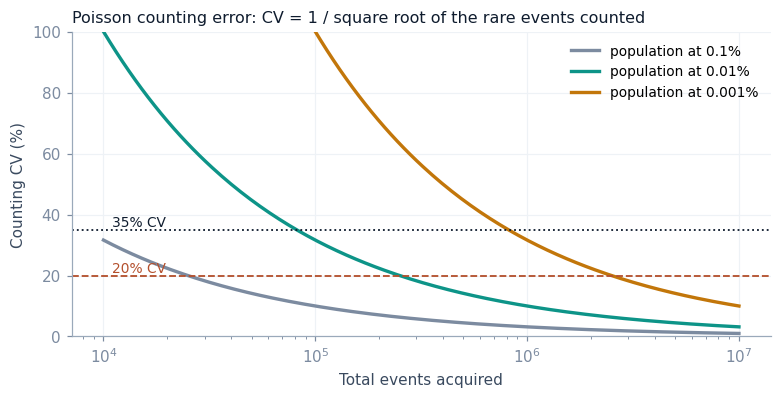
Rare-Event LOQ and Poisson Counting
Why precision for a 0.01% population has a floor set by counting statistics, how many events are needed for 20% and 35% CV, and how to write the LOQ into the method.
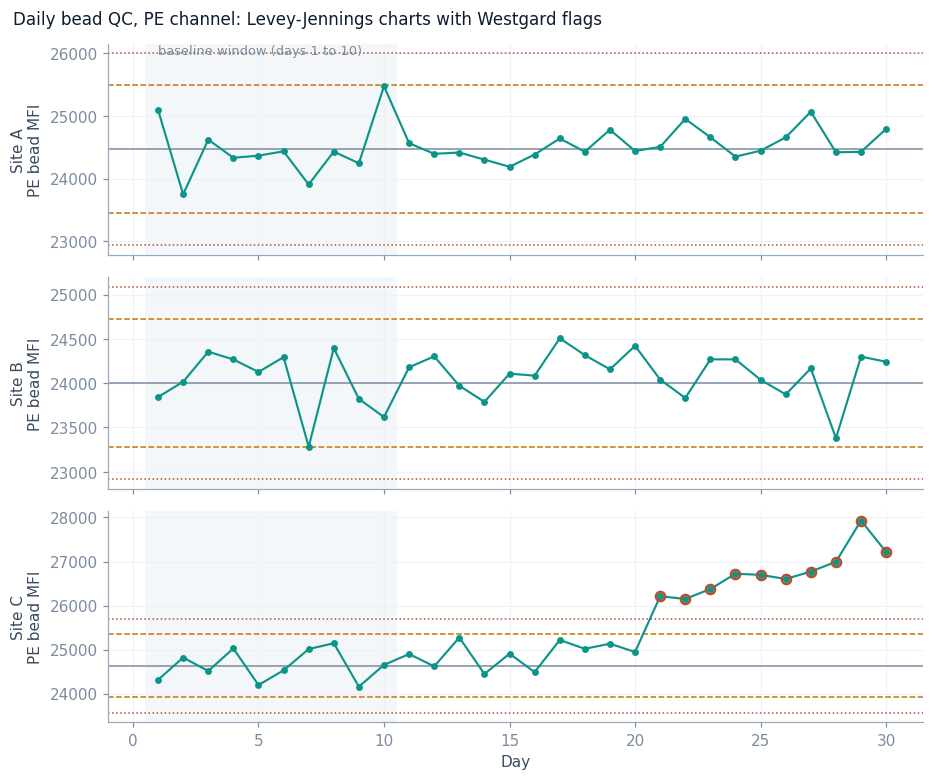
Cross-Site MFI Drift, Caught with Bead QC
Daily bead QC across three sites, tested with Levey-Jennings charts and Westgard rules. Separates drift from variability and shows how a brighter channel moves a dim population across a fixed gate.
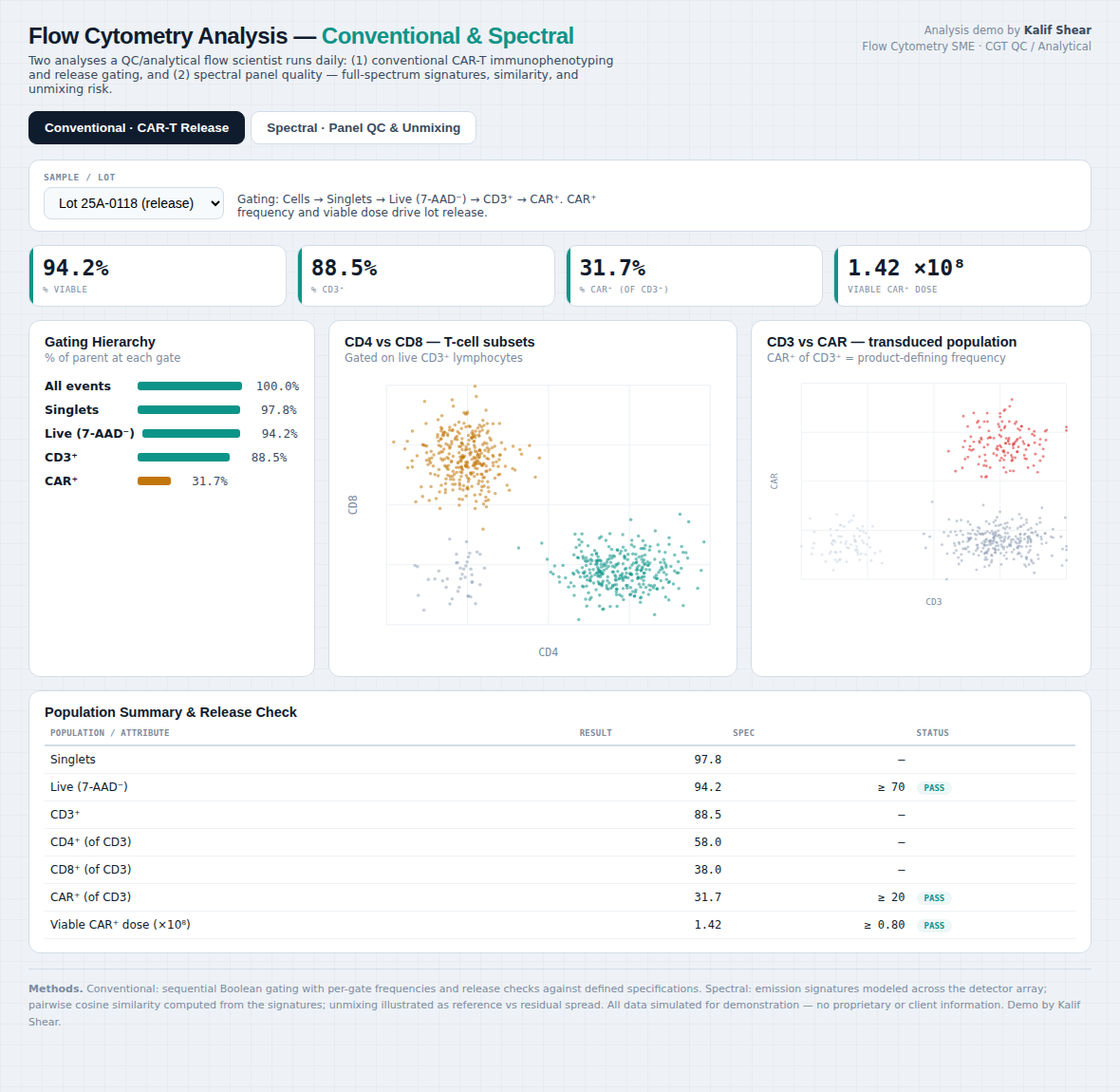
Flow Cytometry Analysis: Conventional and Spectral
CAR-T immunophenotyping and release gating (%viable, %CD3, %CAR+, T-cell subsets, viable dose) plus spectral panel QC: full-spectrum signatures, a similarity matrix, and unmixing-risk flags before samples are run.
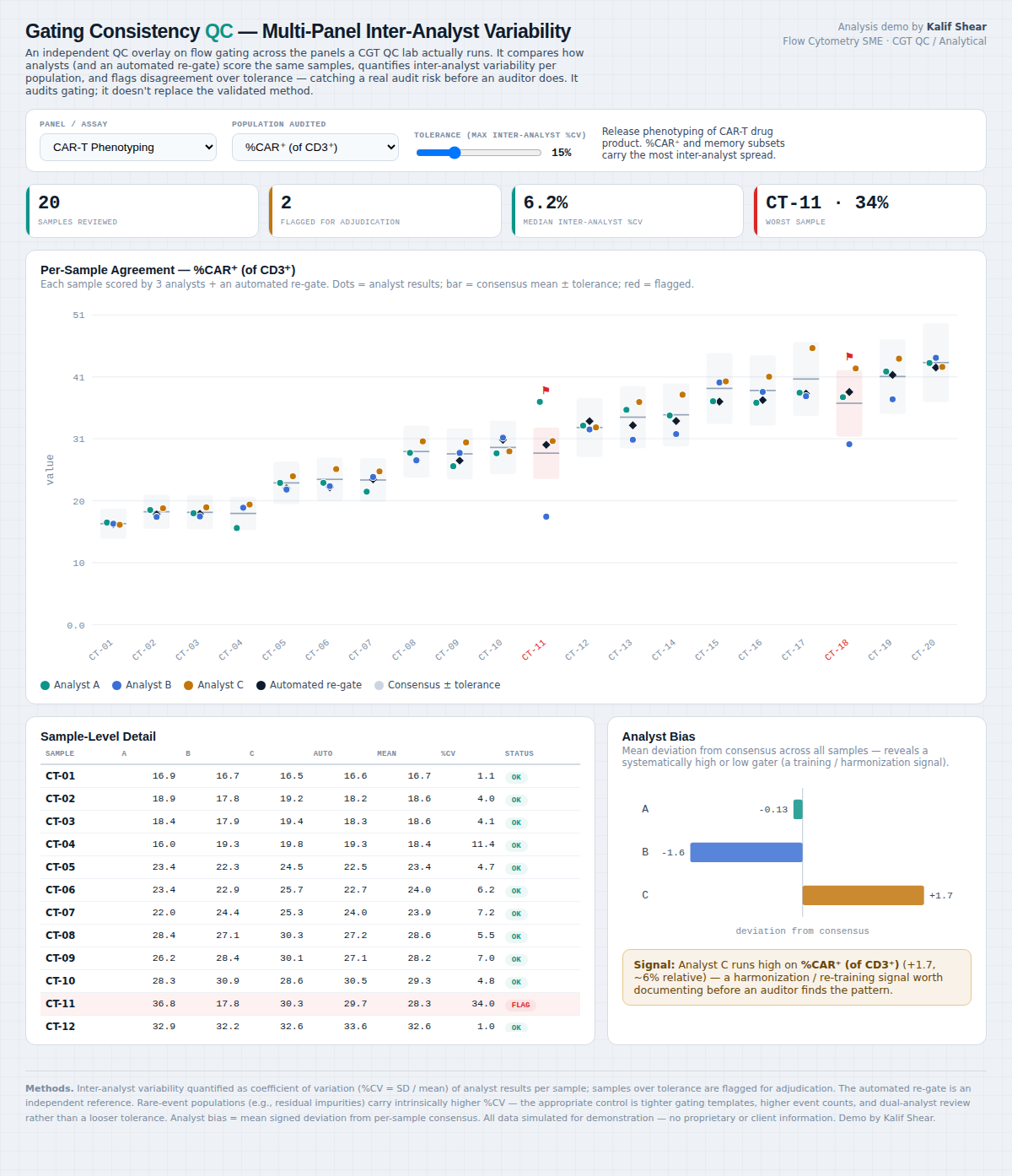
Gating Consistency QC: Multi-Panel
An independent QC overlay on gating across CAR-T phenotyping, PBMC immunophenotyping, CD19 residual impurities, and T-cell purity. Quantifies inter-analyst variability and flags disagreement over tolerance.
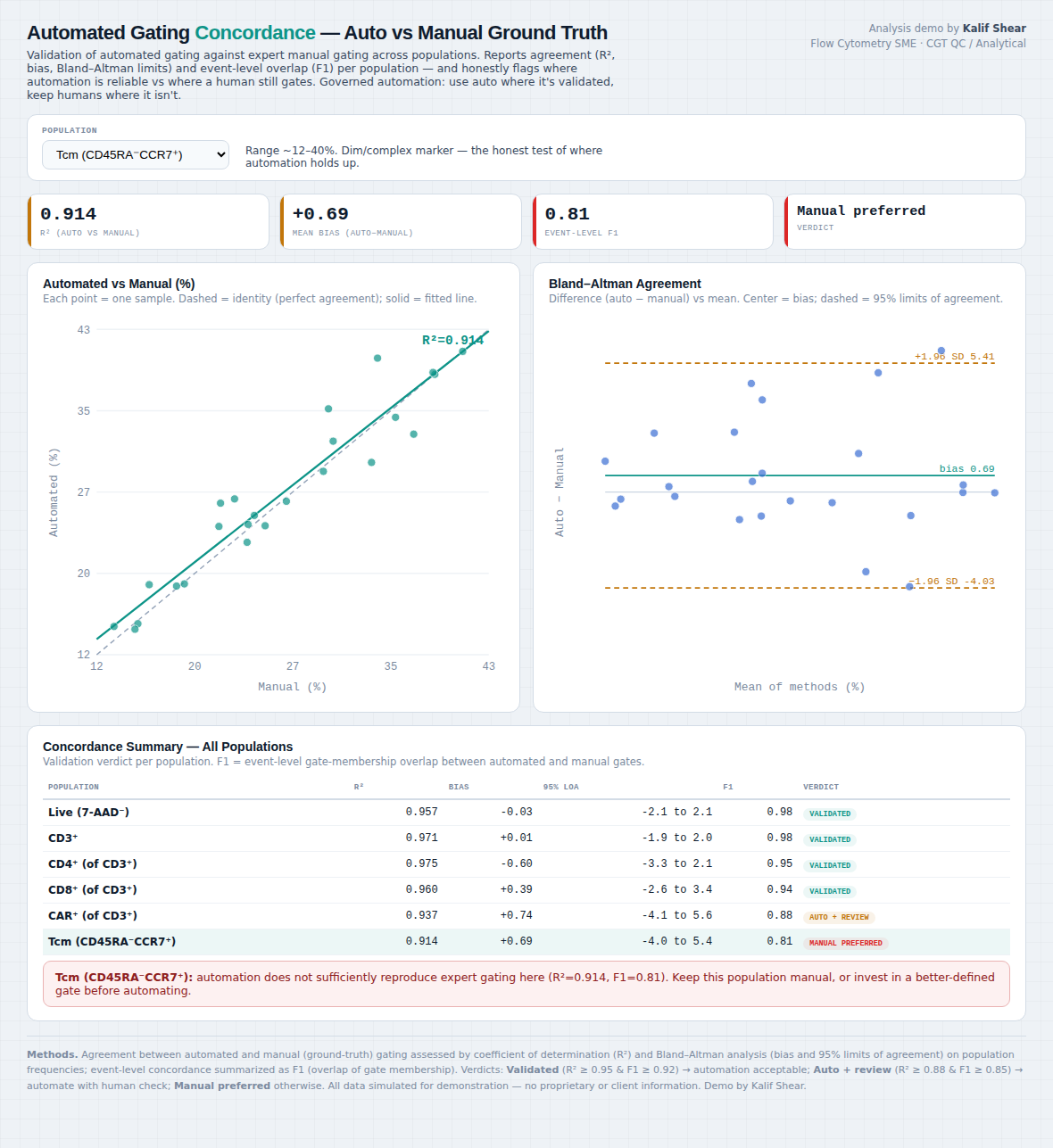
Automated Gating Concordance
Validates automated gating against expert manual ground truth with R², bias, Bland-Altman limits, and event-level F1 per population, and flags where a human should still gate.
Worked analyses and data science tools built in Python and R: method comparison, equivalence testing, stability poolability, process capability, and significance testing. Each worked analysis uses synthetic data and walks from the question to the decision.
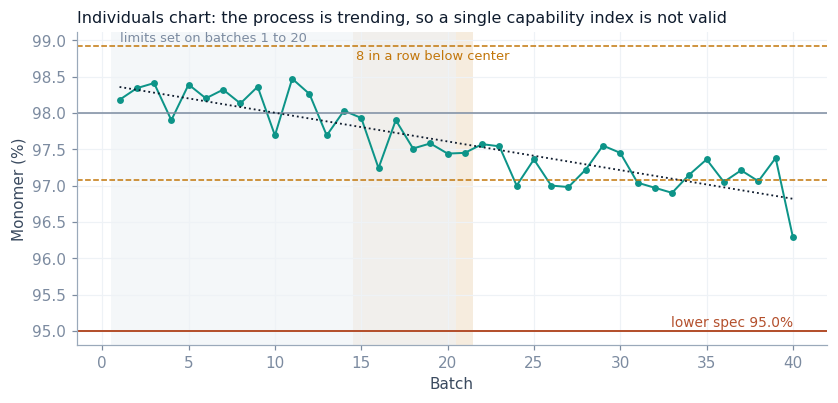
Process Capability on a Drifting Process
A comfortable Ppk over 40 batches hides a downward trend. The individuals chart, run rules, and recent-batch capability show the margin shrinking.
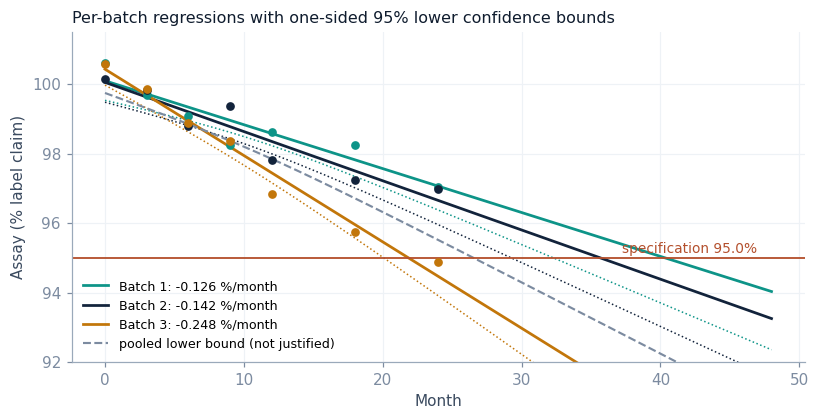
Shelf Life: Can the Batches Be Pooled?
An ICH Q1E poolability test on three stability batches. Unequal slopes mean the shelf life comes from the worst batch, not from pooled data that overstate it.
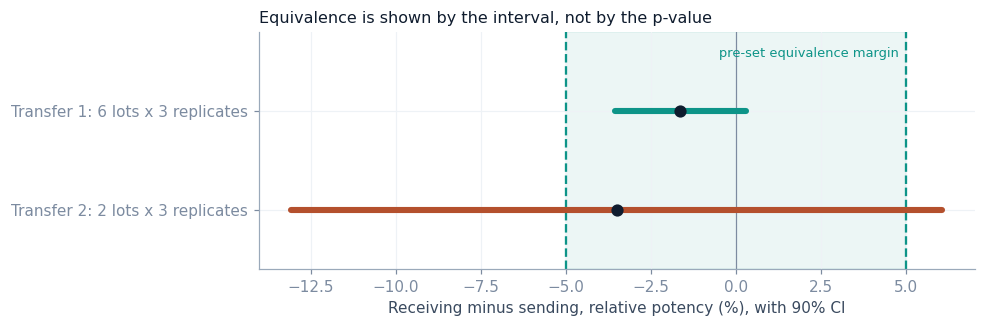
Method Transfer: Equivalence, Not "No Difference"
Two transfers both pass a t-test; only one is equivalent. Two one-sided tests against a pre-set margin show why a small, noisy study cannot prove agreement.
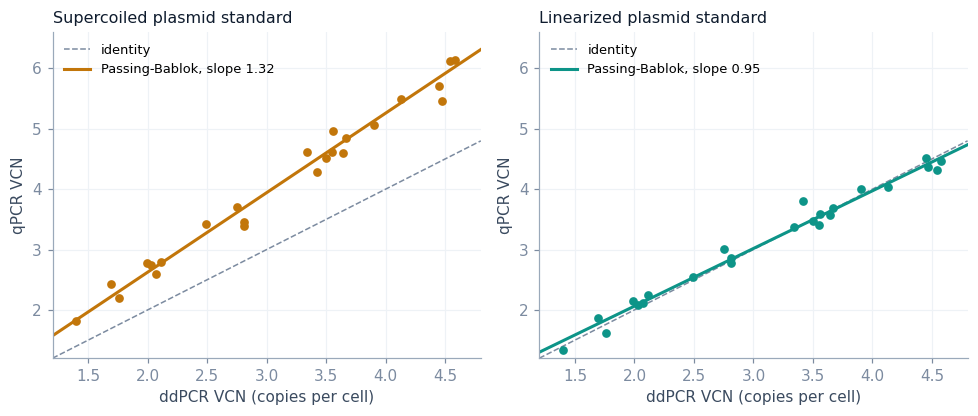
ddPCR vs qPCR: Diagnosing a Copy-Number Offset
Passing-Bablok and Bland-Altman show a proportional bias traced to a supercoiled plasmid standard, and what it would do to lots near a release limit.
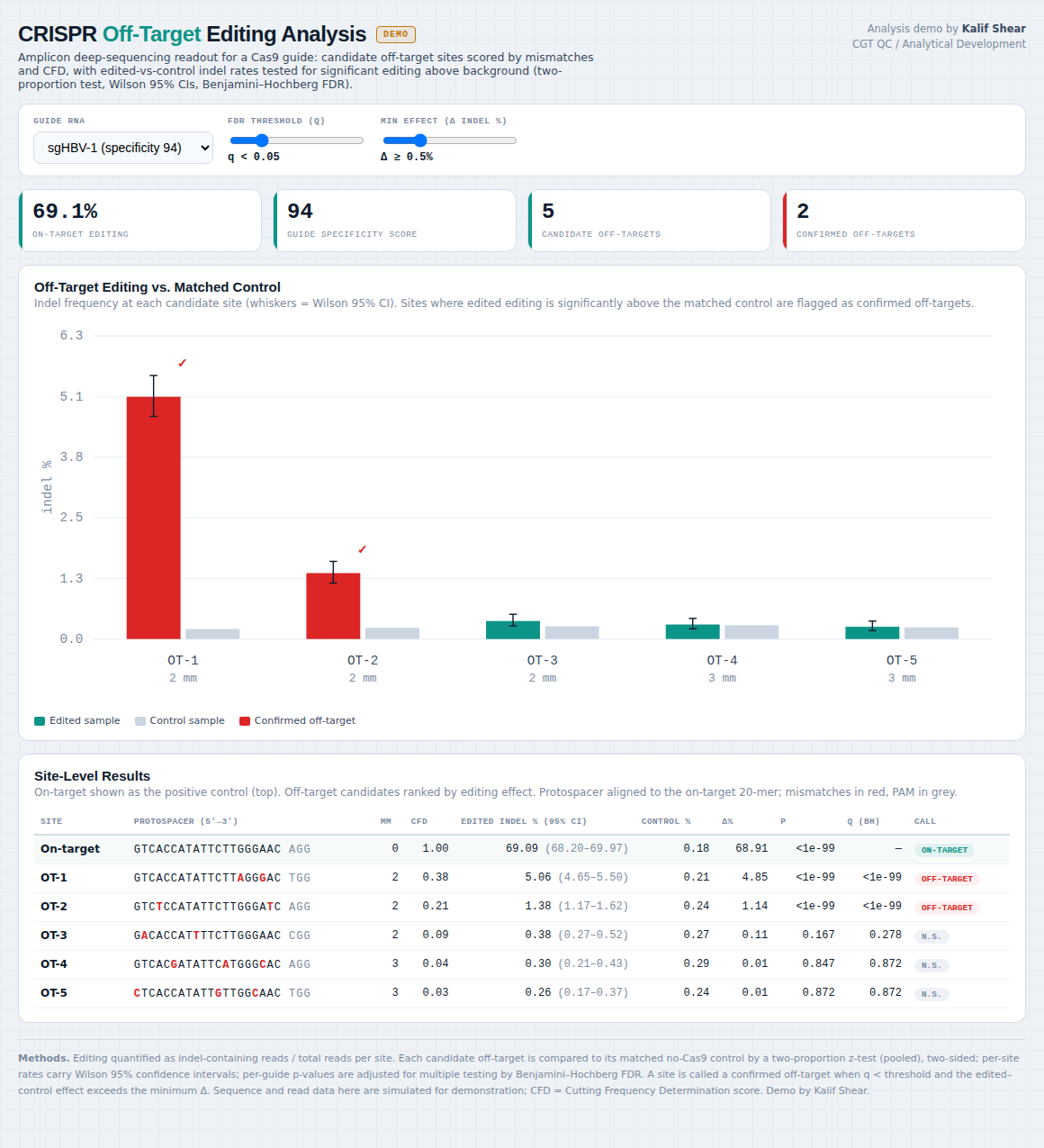
CRISPR-Cas9 Off-Target Analysis
Separates genuine off-target edits from sequencing noise with mismatch and CFD scoring, two-proportion tests, Wilson 95% CIs, and Benjamini-Hochberg FDR correction, cross-checked against SciPy.
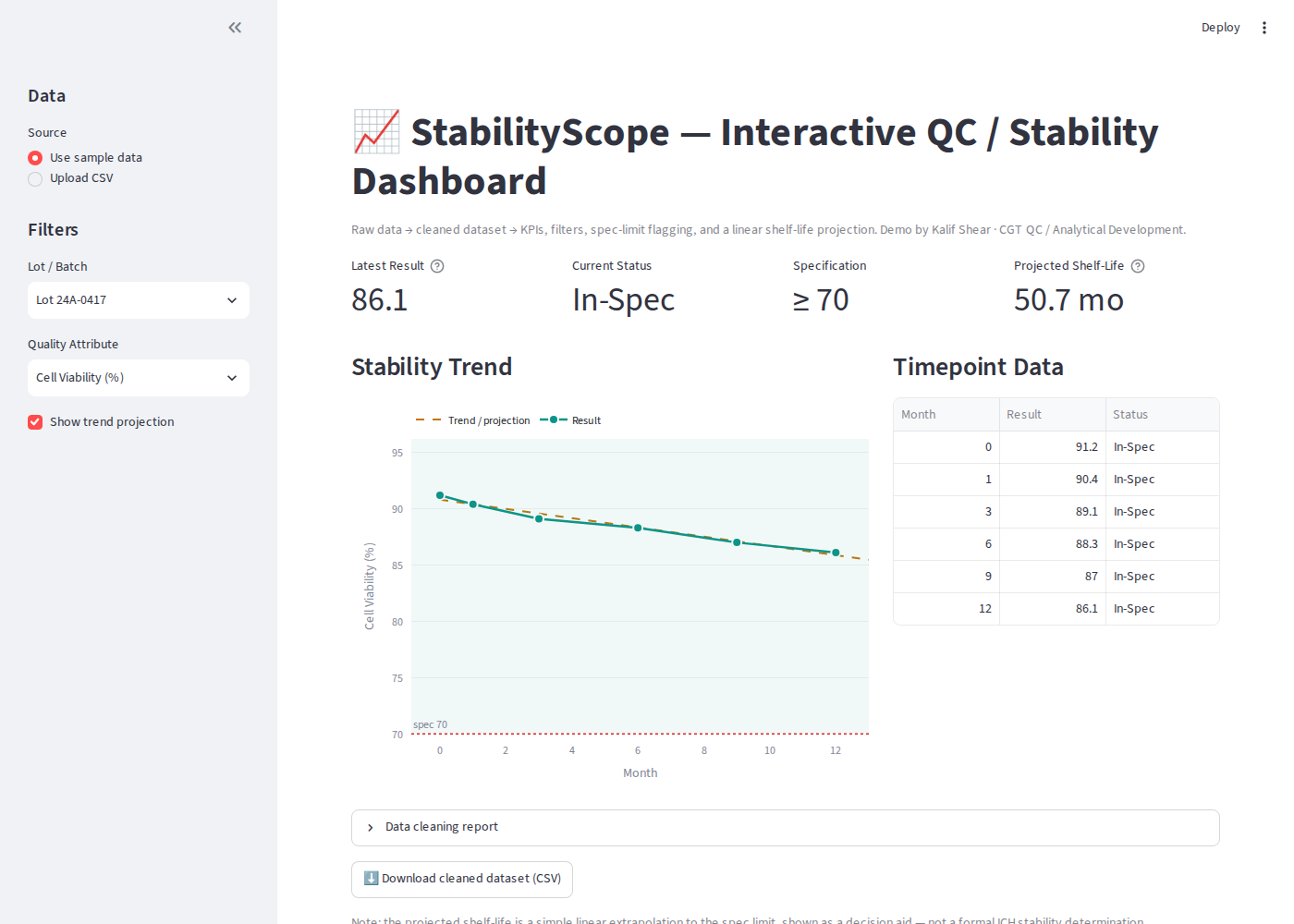
StabilityScope: QC and Stability Dashboard
Turns raw QC and stability data into decisions: cleaning, KPI cards, lot and attribute filters, out-of-spec and out-of-trend flags, and a shelf-life projection.
A six-exhibit packet following one analytical method from creation to the day someone has to prove its numbers can be trusted. Built the way I would build it for a decision meeting.
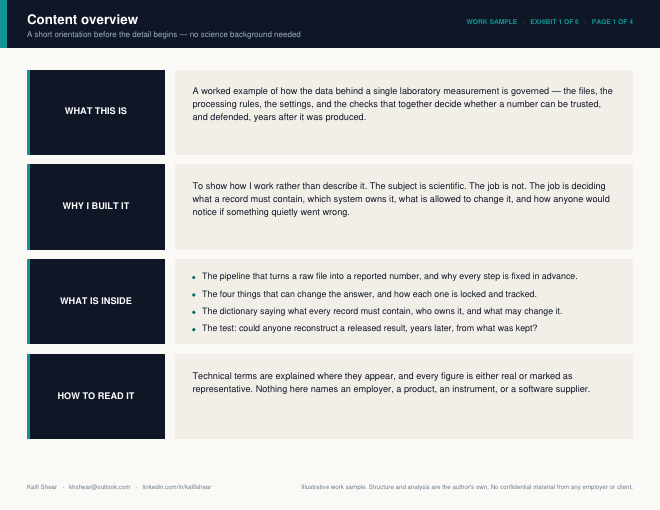
Analytical Data Pipeline
How the data behind a single laboratory measurement is governed: raw files, processing rules, settings, and the checks that decide whether a number can be trusted and defended years later.
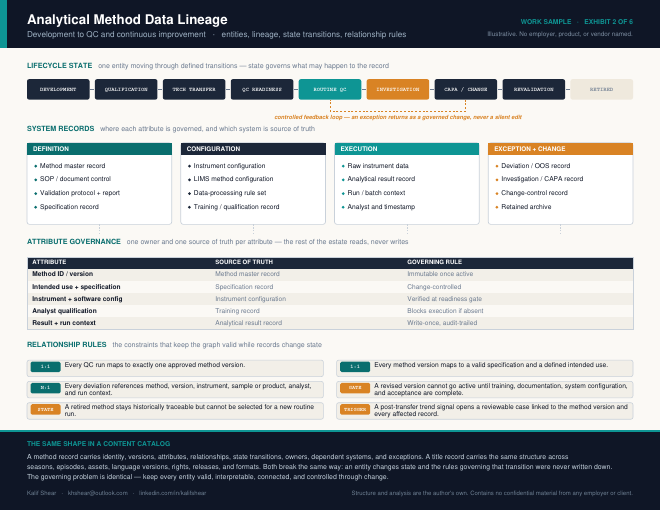
Method Data Lineage
One analytical method traced from development through qualification, transfer, routine QC, investigation, CAPA, and revalidation, with the entities, state transitions, and relationship rules at each step.
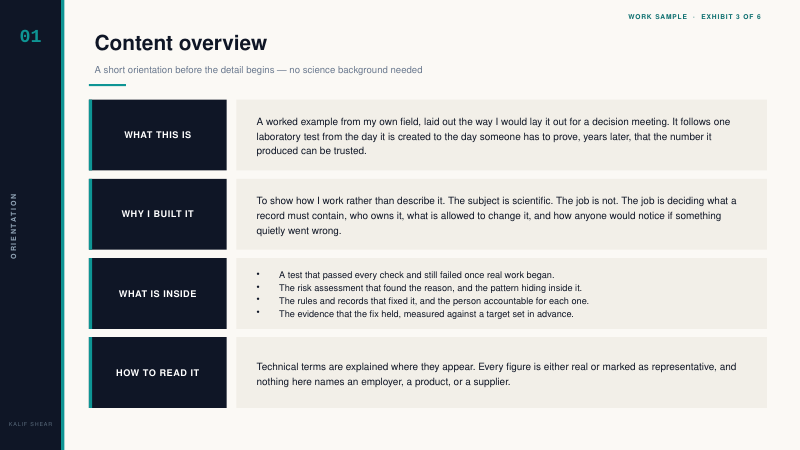
Method Lifecycle Governance
A decision-meeting deck on a method that passed transfer and still failed in routine use: the risk assessment that found the structural cause, the controls that fixed it, and the evidence the fix held.
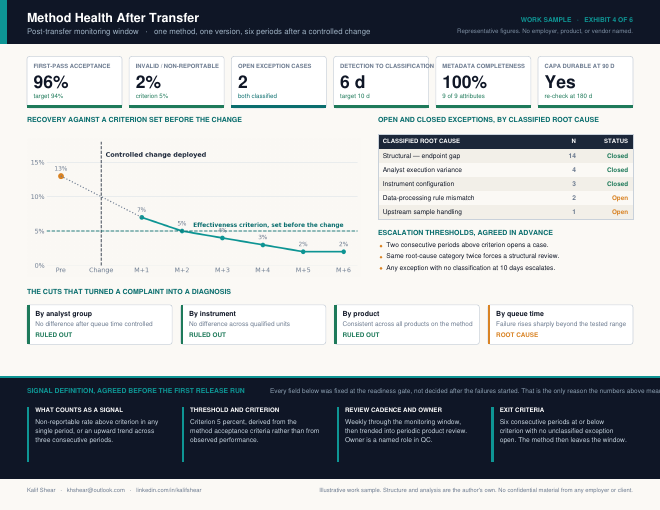
Method Health After Transfer
A one-page post-transfer monitoring dashboard: signals and thresholds agreed in advance, recovery against a pre-set criterion, and classified root causes with escalation rules.
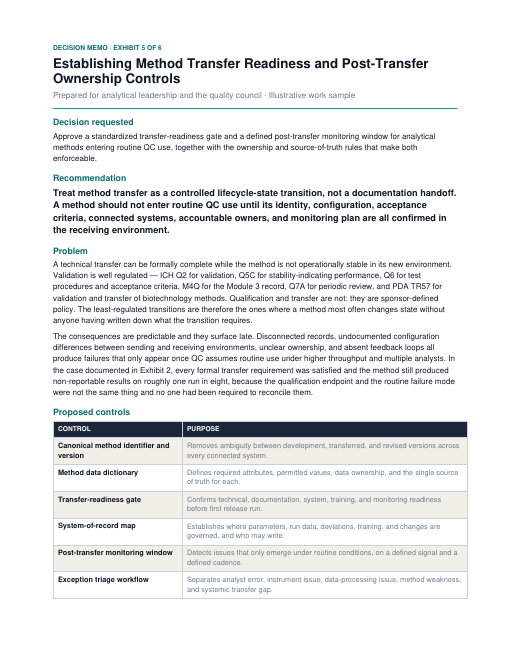
Decision Memo: Transfer Readiness
A two-page memo to analytical leadership and the quality council requesting a transfer-readiness gate and a post-transfer monitoring window, with ownership and source-of-truth rules.
Appendix Workbook
The supporting register behind the packet: every failure mode scored, then re-scored after the controlled change, with live formulas so the change in risk is shown rather than asserted.
Validation, compliance, training, and regulatory strategy documents: the structures I use when an answer has to survive an auditor or an agency.
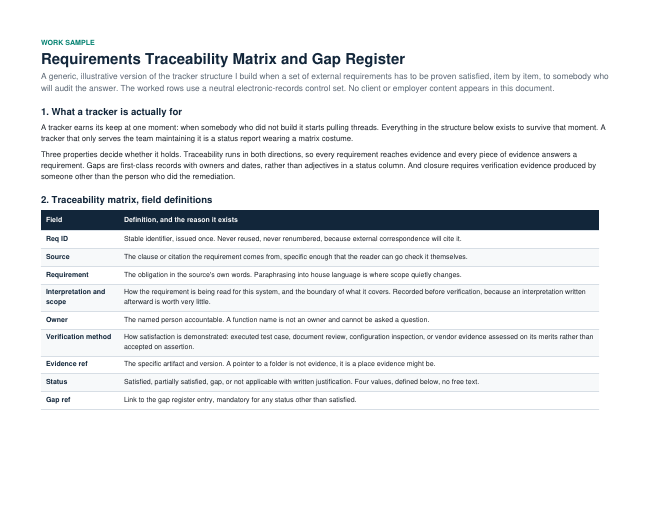
Requirements Traceability Matrix and Gap Register
The tracker structure for proving a set of external requirements satisfied, item by item, to someone who will audit the answer: two-way traceability, gaps as owned records, and independent closure evidence.
21 CFR Part 11 for Flow Cytometry: Training Deck
A 15-slide training deck on electronic records and signatures for flow cytometry labs: audit trails, access control, data integrity, and what an inspector actually checks.
Regulated Discipline, Mapped Across Functions
Twelve GxP controls set against their equivalents in a regulatory inquiry function: same failure mode, same evidence, same reason the control exists.
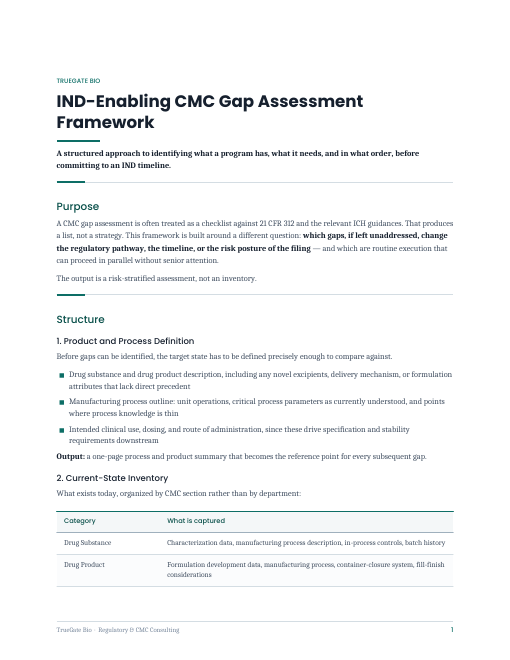
IND-Enabling CMC Gap Assessment
A risk-stratified framework for finding which CMC gaps change the pathway, timeline, or risk of an IND filing, and which can proceed in parallel.
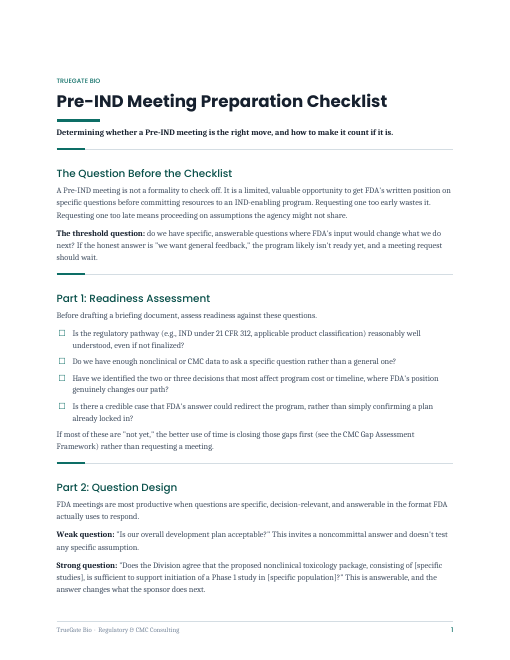
Pre-IND Meeting Preparation Checklist
Deciding whether a Pre-IND meeting is the right move, and how to make it count: readiness questions, question framing, and briefing package structure.
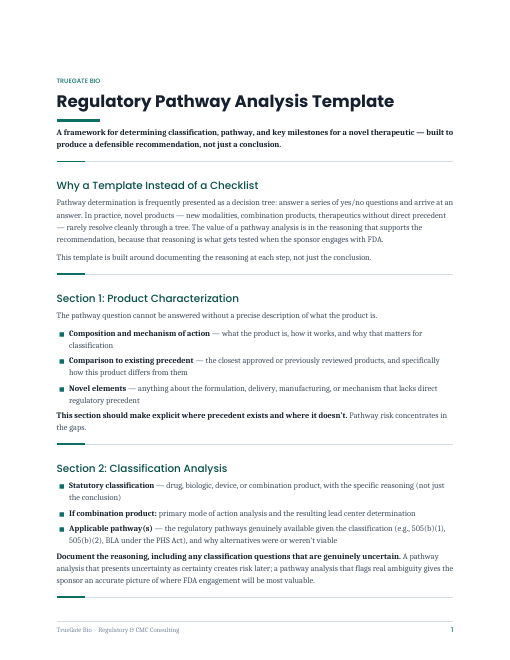
Regulatory Pathway Analysis Template
A template for classification, pathway, and milestones for a novel therapeutic, built to document the reasoning FDA will test, not just the conclusion.
Governed, human-in-the-loop AI tools for the highest-burden GMP documentation tasks. Each drafts fast, checks itself, and flags every point that needs a qualified human.
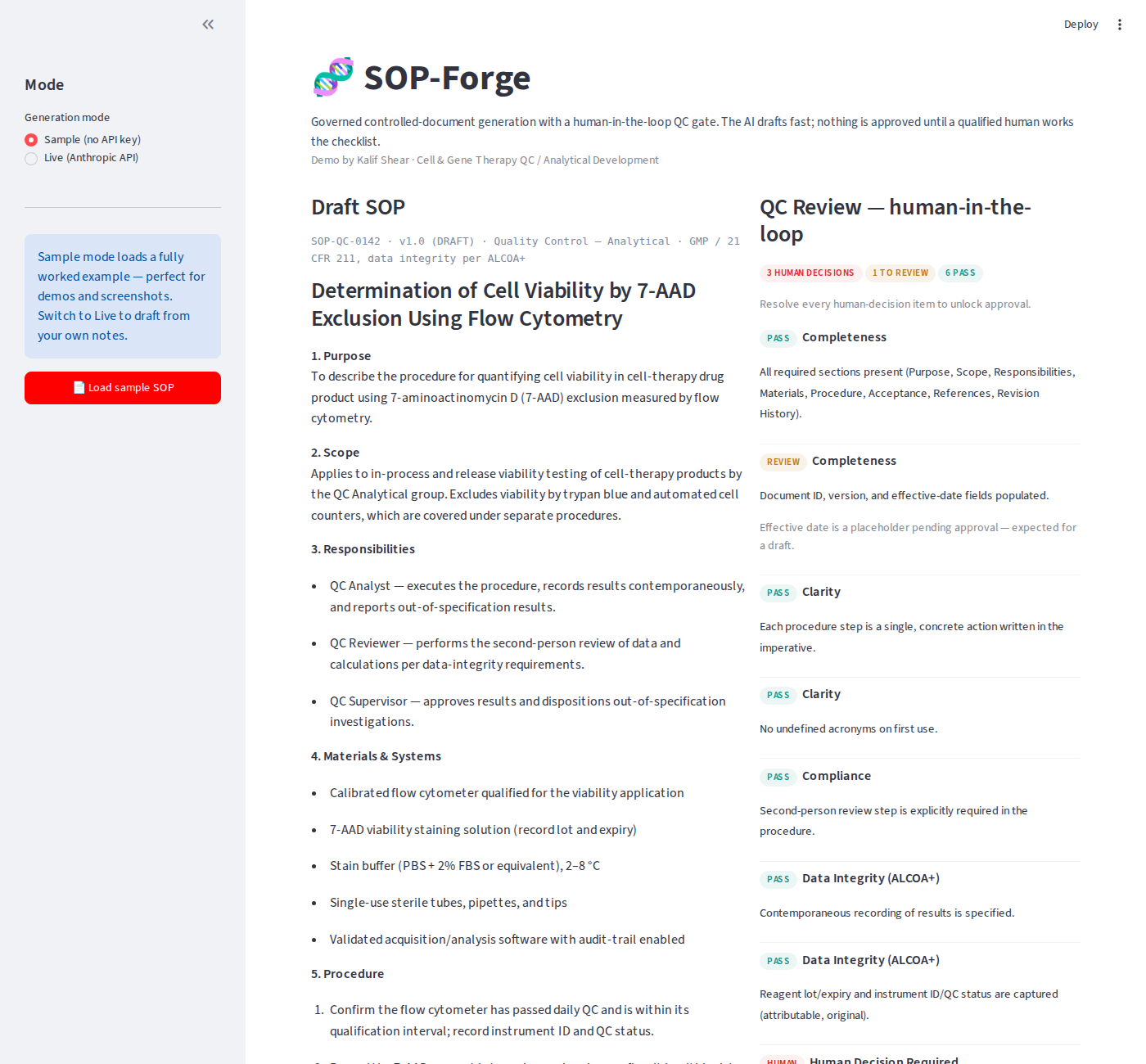
SOP-Forge: Governed SOP Generator
Turns process notes into a review-ready SOP draft, generates a QC checklist, and flags every point that needs a human decision. Nothing is approved until a qualified reviewer signs off.
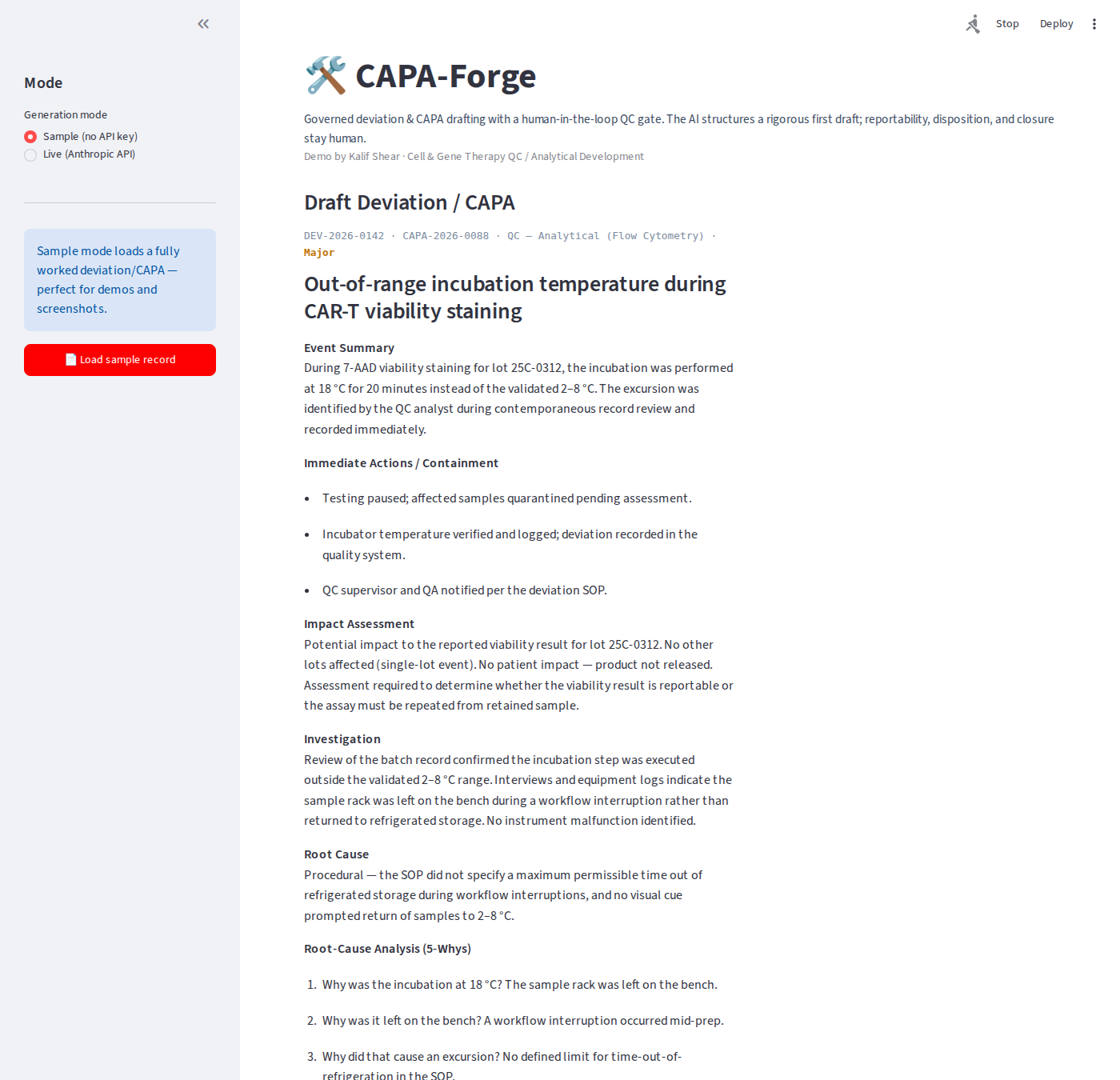
CAPA-Forge: Deviation and CAPA Drafting
Turns an event description into a structured deviation and CAPA: impact assessment, investigation, root cause, action plan, and effectiveness check. Reportability and disposition stay human decisions.
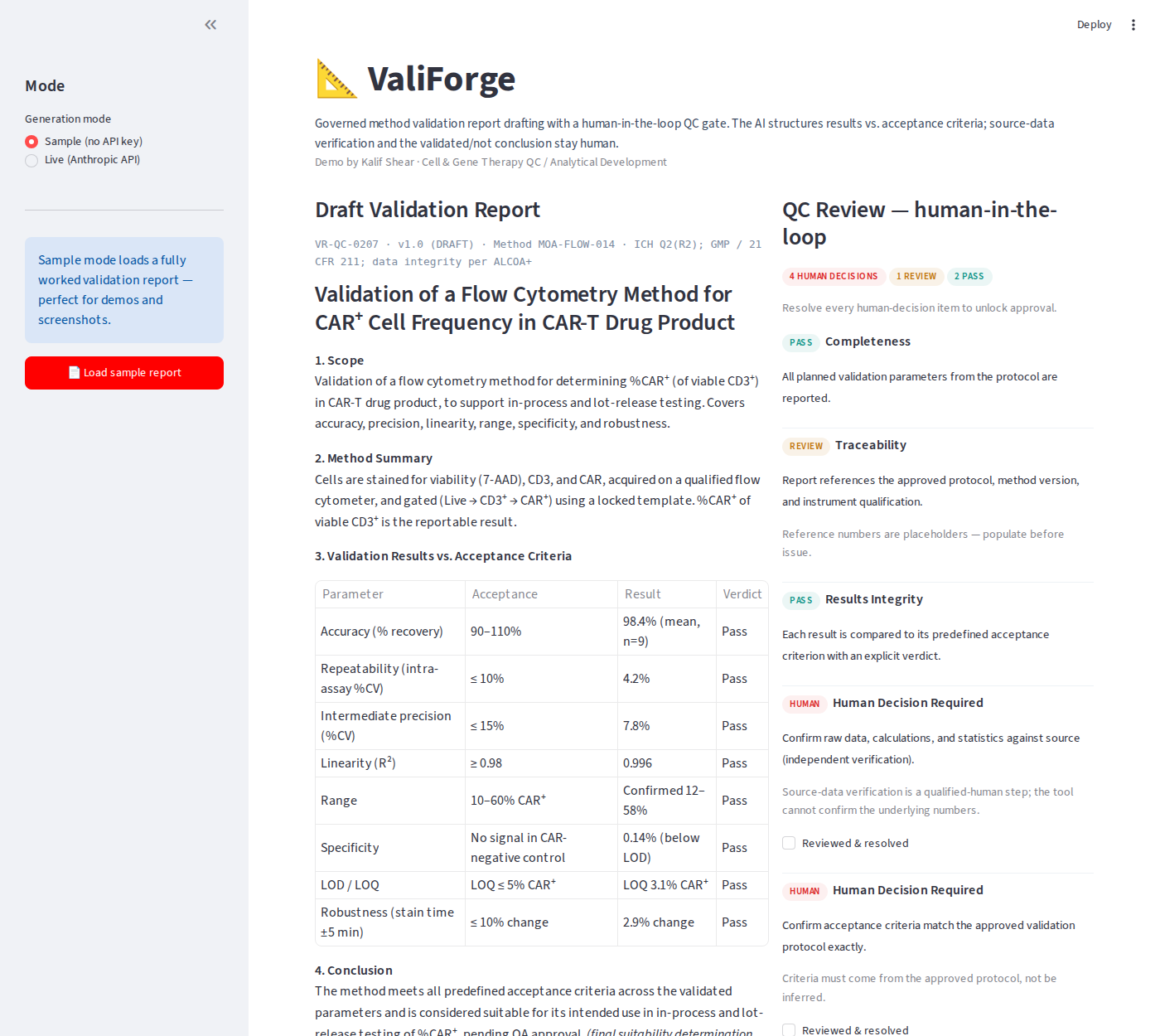
ValiForge: Validation Report Generator
Turns validation study data into a structured report with results against acceptance criteria (accuracy, precision, linearity, LOD/LOQ, robustness), aligned to ICH Q2(R2). The validated conclusion stays human.
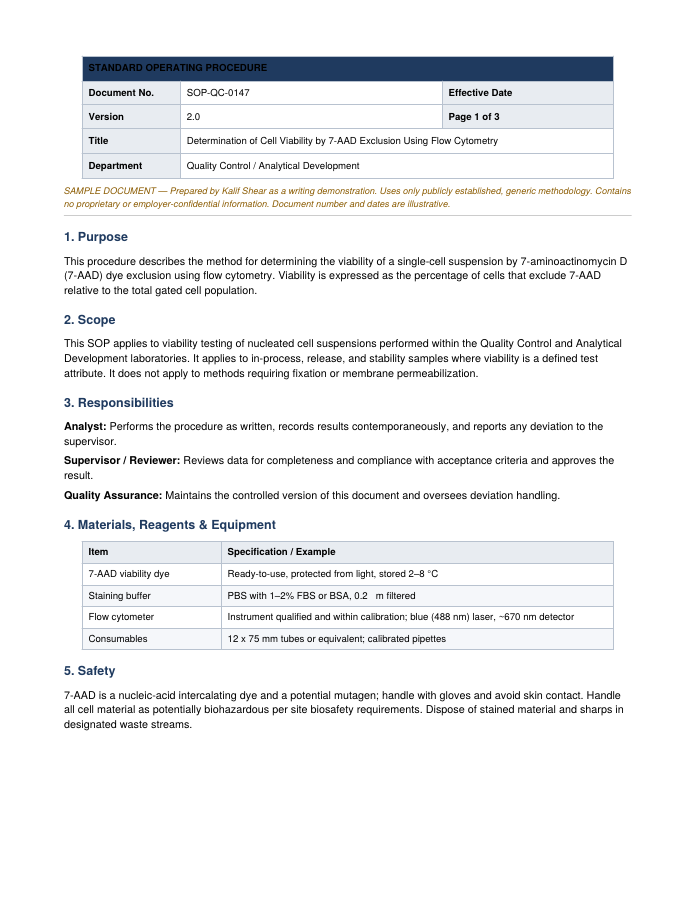
Analytical SOP: Writing Sample
A controlled-document writing sample: a flow cytometry viability SOP structured for GMP use, step by step and audit-minded, with data-integrity requirements built in.